
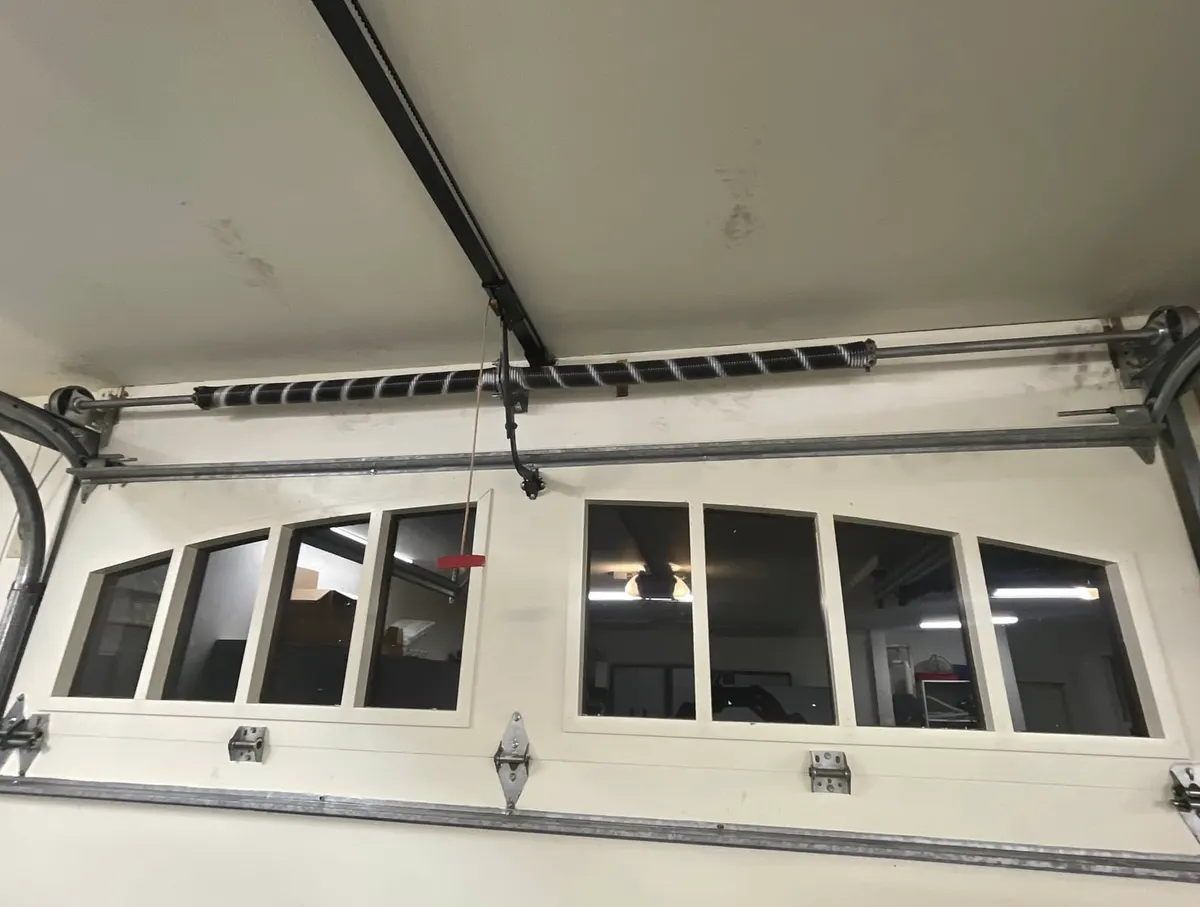
The Rule, and the Exceptions
Never touch a wound garage door spring yourself — that's the rule, full stop. The exceptions are narrow: you can inspect a spring for rust or a visible gap, clean and lubricate the coils, and watch how the door behaves when it opens. None of that involves loosening, tightening, or removing anything connected to the spring. The moment a winding bar or wrench comes into play, this stops being a homeowner project.
What Actually Happens When a Spring Lets Go
A standard garage door weighs somewhere between 130 and 400 pounds depending on size and material. The spring system — torsion springs mounted above the door, or extension springs along the horizontal tracks — is what counteracts that weight so the door feels light enough to lift by hand. To do that, the spring is wound under enormous stored tension, sometimes equivalent to the force of several hundred pounds pulling against a steel rod.
When that tension is released in a controlled way, by someone using the right winding bars at the right length, nothing dramatic happens. When it's released uncontrolled — because the wrong tool was used, the bar slipped, or the spring itself was already weakened and snapped mid-adjustment — that stored energy has to go somewhere. It goes into whatever is holding the bar, standing nearby, or underneath the door at that moment.
The Injuries That Send People to the ER
This isn't a vague safety warning; the injury patterns are specific and well documented across the industry:
- Hand and finger injuries from a winding bar kicking back or a cable snapping under load.
- Deep lacerations from broken spring coils or snapped cables whipping loose.
- Crush injuries when a door that's been disconnected from its spring drops unexpectedly while someone is underneath or reaching into the track.
- Eye injuries from metal fragments when an old, rusted spring fractures under tension instead of unwinding cleanly.
- Fall injuries from ladders, since spring work almost always happens overhead with both hands occupied holding tension.
None of these require a freak accident. They happen during routine attempts, often on the first try, because the person doing the work didn't know how much force was actually involved until it was already loose.
Why This Risk Is a Little Higher Here
Columbia's humidity and heavy rain don't just stress the metal track and hardware — they work on the spring itself. Moisture that collects in a garage, especially one near pine trees shedding sap and needles into gutters and door seals, speeds up surface rust on the coils. A spring that looks intact from the floor can have pitting or thinning you can't see without close inspection, which means it can fail at a different point than expected, with more force released at once than the same spring would release if it were in good condition. Ice storms add another layer: cold snaps make metal more brittle right as homeowners are most likely to go out and troubleshoot a door that's suddenly harder to open.
What You Can Safely Do Yourself
There's real value in staying on top of this without ever touching the spring's tension:
- Look for a visible gap in a torsion spring — that means it's already broken and the door shouldn't be opened until it's replaced.
- Check for rust, flaking, or discoloration on the coils, especially after a wet season.
- Lubricate the spring and moving hardware with a garage-door-specific lubricant (not WD-40, which washes off and attracts grit) a couple of times a year.
- Run the balance test: disconnect the opener, lift the door halfway by hand, and let go. It should stay roughly in place. If it drops or shoots up, the spring tension is off and it's time to call someone — not adjust it yourself.
When to Call Columbia Garage Door Service
If your door fails the balance test, if you see a gap in the spring, or if it's just been a long time since the springs were serviced, that's the point to call in Spring Replacement service. A technician will check both springs (they should be replaced in pairs even if only one has failed), match the correct wire gauge and length for your door's weight, and use calibrated winding bars to set tension safely — then secure the door and retest the balance before leaving. Pairing that with routine Garage Door Maintenance catches rust and wear early, before a spring becomes an emergency instead of a scheduled job.
If your garage door in Columbia, Irmo, Lexington, Blythewood, Elgin, Chapin, West Columbia, or Cayce needs a spring looked at, don't reach for the winding bars yourself. Call Columbia Garage Door Service and let us handle the part of the job that's genuinely dangerous to do alone.