
It usually happens on a Saturday. You're backing the car out, you glance up as the door comes down, and you notice there's nothing down near the floor — no little black boxes on either track, no blinking light. Your spouse says that's a safety hazard and the whole door needs to go. You say it's been closing just fine since before either of you owned the house. Nobody wins, and the door still works, so the argument goes nowhere.
Here's the thing: you're both partly right. A garage door from the 1990s or earlier isn't automatically dangerous just because it's old. But it probably is missing a specific handful of safety features that got standardized later, and those are worth knowing by name instead of arguing about in the abstract.
The Real Question Isn't "How Old" — It's "What's Missing"
Garage doors don't expire on a calendar. A well-built door from decades ago, properly maintained, can still be structurally sound. What changed over time wasn't the steel or the wood — it was the required safety hardware. If your door and opener predate those additions, the door itself might be fine; it's the safety systems around it that need a look.
Three Things Worth Retrofitting Right Now
1. Photo-Eye Sensors
These are the two small sensors mounted a few inches off the floor on either side of the track, with a beam between them. If something breaks that beam while the door is closing — a kid, a bike tire, a dog — the door is supposed to stop and reverse. Older openers often relied only on a mechanical force-sensing reversal, which can fail or get out of adjustment over years of use. If you don't see sensors down there at all, this is the single most worthwhile retrofit, and it's a relatively small job to add a compatible sensor kit to most openers.
2. A Working Manual (Emergency) Release
Every garage door opener has a red cord hanging down that disconnects the door from the motor, so you can open it by hand during a power outage or if the opener fails. On older systems, that release mechanism sometimes gets painted over, rusted, or simply forgotten. Test it: pull the cord with the door closed and see if it actually disengages smoothly. If it's stiff, seized, or nobody in the house knows what it does, that's a retrofit-or-repair item, not a replace-the-whole-door item.
3. Spring Containment Cables
If your door uses a torsion spring (the kind mounted horizontally above the door) or extension springs (stretched along the upper tracks), check whether there's a thin cable running through the spring. That cable keeps the spring from becoming a projectile if it snaps under tension — and springs do eventually fail, often without warning. Older installations sometimes skipped this, especially on extension-spring setups. Adding containment cables is inexpensive compared to the alternative of a spring letting go near someone standing in the garage.
What You Can Safely Leave Alone
- Solid panels with no rust-through or delamination. If a steel door isn't rusting from the inside out and a wood door isn't soft or swollen, the panels themselves don't need replacing just because of age.
- An original torsion spring that's properly sized and recently serviced. Age alone doesn't mean imminent failure — cycle count and maintenance history matter more. A spring that's been inspected and is still within its reasonable lifespan doesn't need preemptive replacement.
- An older opener that already reverses reliably. If it has a working mechanical reversal and you add photo eyes, you've closed the real safety gap without buying a whole new system.
In other words: old doesn't mean broken, and a full replacement isn't the only honest answer here. Sometimes it's the right call because of rust, warping, or a chain of repairs that's starting to add up — but that's a different conversation than "it's from the 90s."
Where Columbia's Weather Actually Changes the Calculus
A few local realities push some of these decisions one way or the other. Humidity and pollen here mean tracks and rollers collect a sticky film faster than they would in a drier climate, which puts more strain on an aging opener motor and makes force-sensing reversal less reliable over time — another reason photo eyes matter more here, not less. Heavy rain and occasional standing water near garage slabs can accelerate rust at the bottom corners of steel panels and on older, unprotected springs, so that's worth a flashlight check even if the door still looks fine from a few feet away. And since hurricane remnants reaching inland sometimes knock out power for a stretch, a working manual release isn't optional — it's how you get the car out when the opener has no juice.
How to Settle the Argument Yourself
- Close the door and watch for sensors near the floor track. None? Note it.
- Pull the manual release cord and confirm it disengages smoothly.
- Look at the spring for a containment cable running through it.
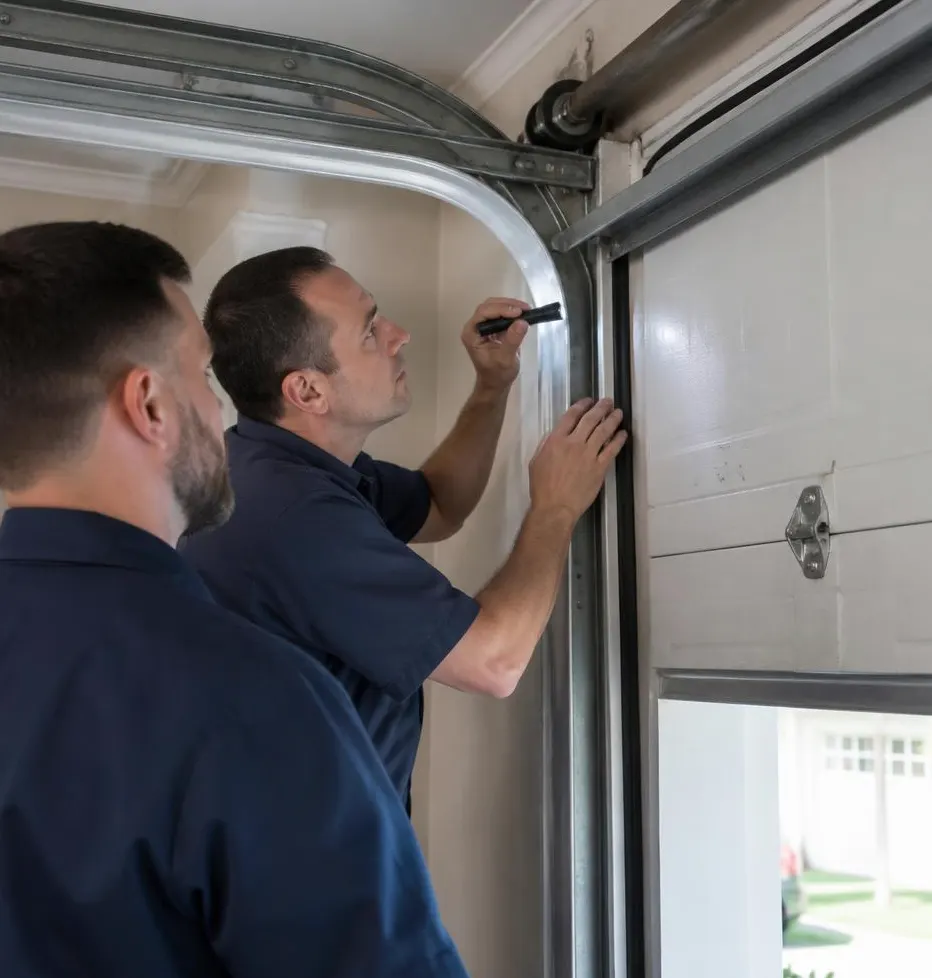
- Check panels and spring hardware for rust, especially at the bottom corners and near the floor.
- Test auto-reverse by placing a 2x4 flat on the ground where the door closes — it should stop and reverse on contact.
If all of that checks out, you've got an old door that's aged well. If two or three items fail, you've got a retrofit list, not a replacement bill.
When to Call Columbia Garage Door Service
If you run through that checklist and find a missing containment cable, a stuck manual release, or no photo eyes at all, that's exactly the kind of job worth having someone experienced handle — spring tension and opener wiring aren't forgiving of guesswork. We handle garage door maintenance visits that check all of the above in one trip, and we do opener installation and repair when it's time to add modern safety reversal to an older setup. Either way, you'll walk away with a straight answer about what your door actually needs, not a sales pitch for a full replacement it doesn't.
If you're in Columbia, Irmo, Lexington, Blythewood, Elgin, Chapin, West Columbia, or Cayce and you want a second opinion on an older garage door, give Columbia Garage Door Service a call — we'll tell you straight whether it's a retrofit or a replacement.